Showing posts with label fit. Show all posts

Thursday, October 15, 2009

Back to the Basics: Fit and Silhouette

If Fabric is the soul of the suit, then Fit and Silhouette are most assuredly a suit's mind and body, respectively. For without a mind a body is useless and without a body the mind is unable to express itself.

What does all that mumbo jumbo mean?
Fit and silhouette, while seemingly the same thing are two completely different ideas.

Fit describes the way a suit (or any garment for that matter) has been tailored, molded to the wearer's body. Simply put, Fit is the way a suit fits. A suit should ideally fit or wear like a second skin; if it doesn't then the suit has a poor Fit. One major thing that affects Fit are those pesky armholes, for if the armholes are not shaped and sized correctly to the specific customer then no amount of tailoring will help the rest of the suit fit right. A suit should fit the wearer in the shoulders, armholes, waist and hips.

Below is an example of a poorly fitted suit, courtesy of Thom Browne:


click to enlarge


Silhouette describes the outward appearance of a suit. This, unlike Fit, can vary from suit to suit according to the wearer's preferences. We see great variance of Silhouette throughout the Golden Era: from the slim and trim of the 1920s, the natural and trim of the 1930s and the big and bulky of the 1940s and early 1950s to the slim and trim of the 1960s, full circle.

Silhouette is affected by the amount of padding in the shoulders, the amount of waist suppression (or lack thereof) and the length of the jacket just to name a few. And, while a suit can be made to fit nearly any body shape, certain silhouettes can only go with certain body shapes.

For example, a heavy man cannot have a well fitted suit with the same amount of waist suppression as a skinny tall man can. The physics of it just will not allow it to happen.


click to enlarge


So, which is more important? Fit or Silhouette? I would have to say Fit. A well fitted suit with poor silhouette is still well fitted and will be comfortable for the owner to wear, even if it makes him look like a blimp. A poorly fitted suit with great silhouette will be too uncomfortable for a man to wear and it will become a hated thing, a uniform. That is the problem with suits today: they are poorly fitted and so uncomfortable that most men hate them and wear them only when they must.

Suits shouldn't be uniforms. They should have both Fit and Silhouette.

Sunday, August 10, 2008

I Have Returned...with Treasure

You'll have to forgive my lack of substantial posting as I've been housesitting for several weeks and had limited internet access.

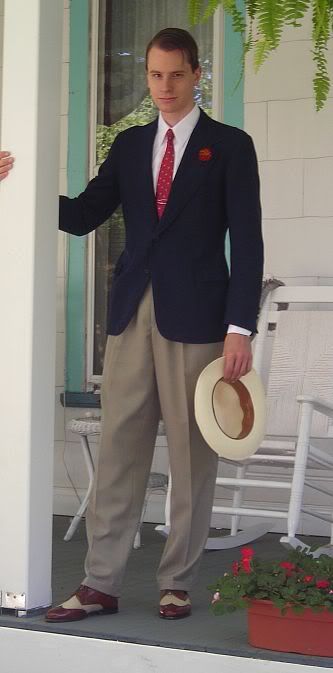
What I wore today:
*Late-1930s belted back jacket
*Modern 'fitted' Van Heusen shirt
*1930s tie
*Modern trousers
*Modern Bostonian spectators
*Modern Stetson Open Road panama
*Marigold in the lapel buttonhole


Click to enlarge.

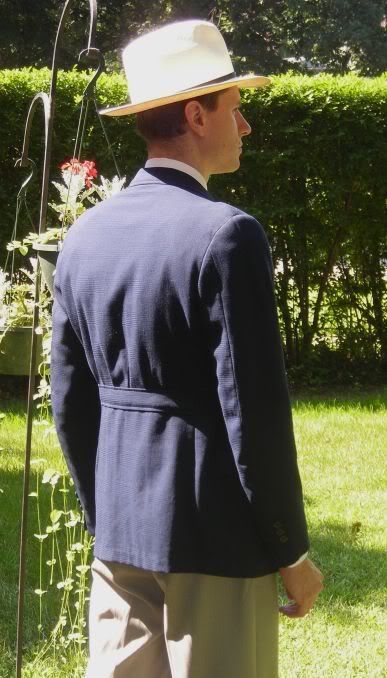
The above photo shows the belted back to advantage.
This is quite the jacket. It is new to me as I bought it several days ago. After a quick restitching and pressing it was in wearable condition. I bought it for what I consider a very good price considering the demand for vintage clothing is on the rise.
This jacket has a 1936 union tag, indicating that it was made sometime between 1936 and 1939, the date when the next style of union tag came into use.
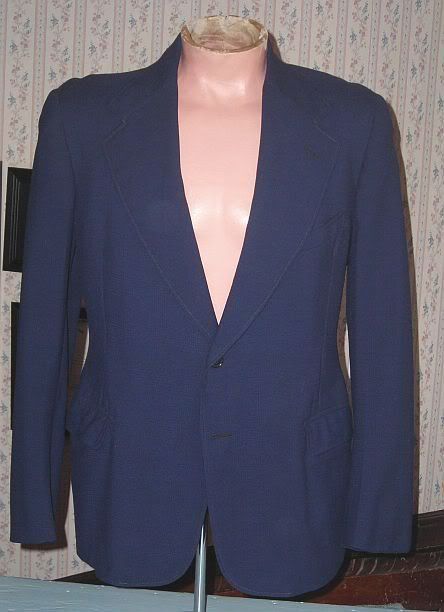
I believe the material to be worsted wool. The material is all round dark blue but there is a woven glen plaid pattern. I've been able to capture this pattern in a few of the pictures below. The pattern is quite delicate and difficult to see even in person.
Note the very angled breast pocket, a common feature of 1930s jackets.

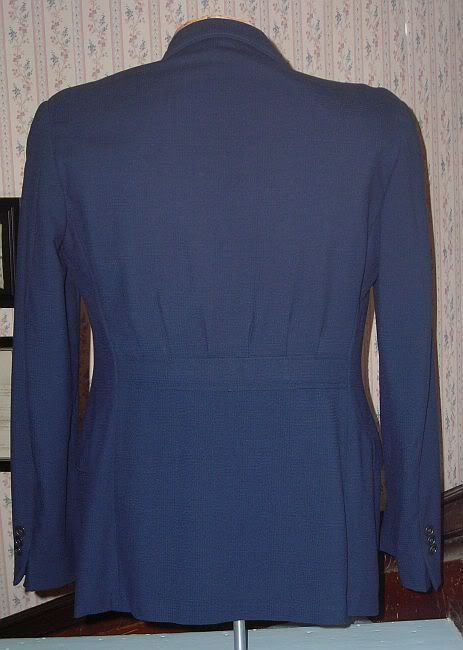
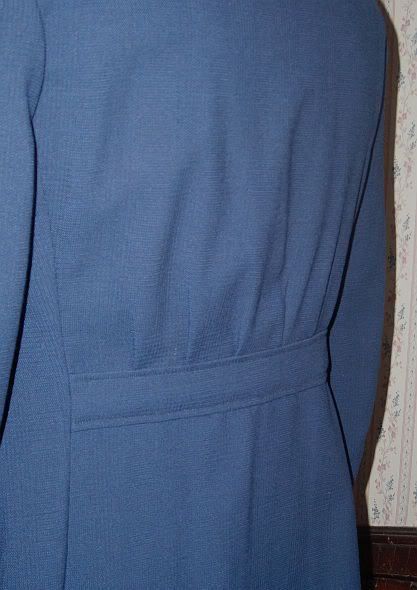
The belted back with pleats. Belted backs were common in the 1930s and came back into style for a short time in the early 1970s, though they were not done as well as in the 1930s. The belted back, one of my favorite back treatments, is a stylistic piece and is in no way utilitarian. It helped give the wearer the appearance of a pinched waist and this, combined with action backs and pleats as shown below, allowed the wearer to move more freely. High armholes are also important in that equation.
A closer view of the pleats and belted back. The woven pattern is also visible in this view.

This jacket gives us a rare look at as to why vintage pieces are a step or two above modern pieces we see today: better fabrics, high quality design, fit and construction and the use of seemingly rare and unusual treatments such as the belted back and the action back.

LinkWithin

Related Posts with Thumbnails