Friday, February 8, 2008

The Most Flattering

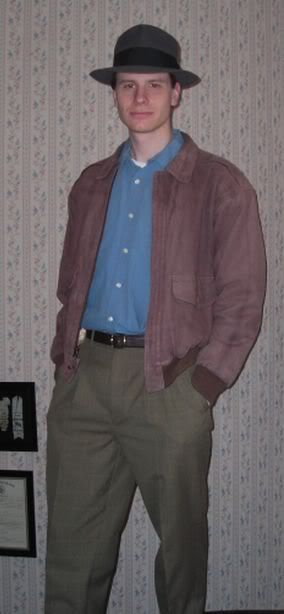
Today I wore my vintage Stetson 3X Open Road fedora. It was originally sold at J.C. Petersens, my great-great grandpa's haberdashery, back in the 1950s.


I was at Wal-Mart with this hat and an older gentleman approached me.
--------------------------------------------------------
Him: Can I ask you a question?
Me: Sure.
Him: Where'd you get that hat?
Me: I bought it at an antique shop.
Him: Really? Well, would you want to sell it?
Me: No, sorry.
Him: Well, I shouldn't wonder why, you look good in it.
Me: Thank you.
Him: They don't make 'em like that anymore.
Me: No, they really don't.
--------------------------------------------------------
Some people can still spot quality when they see it.

Tuesday, February 5, 2008

Highwayman

Inspired by some of the flight jackets found over at the Fedora Lounge, both vintage and modern, I took it upon myself last year to paint my very own World War Two-style flight jacket.
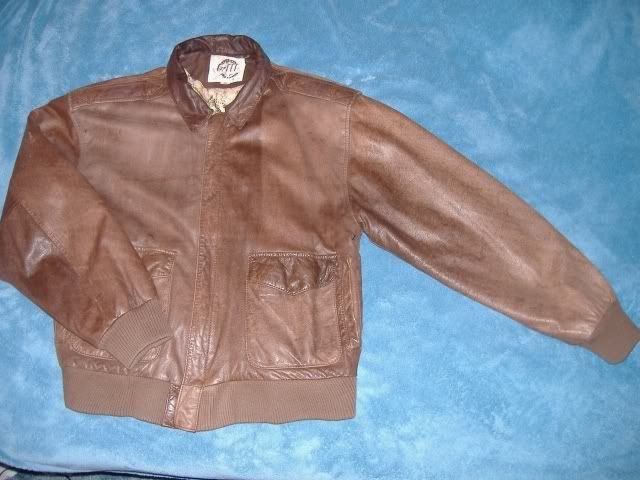
I bought the below A-2 style jacket at a garage sale for $3. It is not styled authenticly like a WW2 jacket but it does need to be perfectly authentic, especially since this is my first painted jacket. It fits well though is quite worn. The knit waistband is stretched. Yet these scars add a pinch of attitude and "combat wear" to the jacket.


I first started by deciding what I was going to paint on the jacket. I chose to paint the shield of the 56th Fighter Group on the left breast. Why the 56th? Because they were major users of the P-47 Thunderbolt, my favorite fighter of the Second World War. Anyways, the P-47 doesn't get enough credit.

I printed off the shield in the size I wanted, cut it out and traced the outlines in correct position on the jacket. Then, using acetone, I stripped the outlined area of any 'finish' the leather might have. I also lightly sanded the area with very fine sandpaper. This allows the paint to soak into the leather as well as give a rough texture to grab onto.

I then applied mulitple coats of watered down acrylic paint (I used craft paint that can be found at Wal-Mart). Thin coats allows the paint to soak into the leather so many coats must be applied to reach the desired vivid colors. Below is the nearly finished shield.

"Cave Tonitrum" is latin for "Fear the Thunderbolt", Thunderbolt being the nickname of the P-47.
After the shield was finished on the front I repeated the above technique on the back except with a different design. The finished product is below.


The plane is in the colors of the 56th FG. The "Highwayman" is yellow with a red outline on one side, giving the name a nice 3-D effect often seen on period flight jackets. I chose the name "Highwayman" as a tribute to the song by Johnny Cash, Willie Nelson, Waylon Jennings and Kris Kristofferson. The song can be found here.

After a bit of wear there is some paint flaking but this is normal and is easily fixed by reapplying paint to the flaked areas. A protective coat of clear sealer can be applied to give the artwork better protection and an extended lifespan.

Calling this type of project 'artwork' is not a misnomer. World War Two era painted jackets are quite collectable and go for large amounts not only because they are interesting to look at but also because they often can be identified to a specific unit and possibly a single pilot. Modern painted jackets are just as rare as vintage ones and are highly prized by their owners. The artwork adds a sense of personality to the jacket and lets the owner seemingly glance into the life of a long gone era when pilots wore painted jackets and flew prop-driven cadillacs of the sky.

Sunday, February 3, 2008

What I Wore Today

I wore this Howard Hughes inspired look yesterday:


And today I wore this:

Thursday, January 31, 2008

Suit Project

I am currently working on a vintage-style 3-piece suit. This is a big project and any helpful comments and concerns are much appreciated.


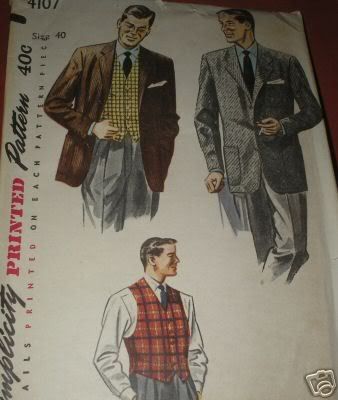
I bought this 1952 dated suit jacket and vest pattern off the Bay. While the jacket pattern is complete and uncut the vest pattern was missing. This vintage pattern will insure higher armholes than a modern jacket pattern.

As a result of the missing vest, I bought a modern pattern not only for the vest but also for the trousers.
Since the vest is not of vintage style (too long and only has two pockets) I used a vintage vest as a guide and altered the pattern a bit. I shortened it about an inch and altered the points at the front, making them a bit longer and more pointed. Here's what it looks like on a torso.

Note that the bottom 1 1/2" of the pattern is to be hemmed so the vest will be shorter than it appears in these photos.

The trousers look good and are relatively straight legged with cuffs and some pleats so no alteration will be needed there. However, they are somewhat low waisted so I will be adding about 3-4 inches to the rise. This will allow the trousers to be worn with the short vintage-style vest.

I have cut most of the fabric for the vest and the pieces are in good order. Speaking of fabric, here is what I am using:
As you can see it is an attractive brownish gray medium weight twill with some nice pin/chalkstripes. It was on clearance at a local fabric shop and I bought all 5 1/2 yards of it. Hopefully it will be enough for the project. I washed and dried it in order to make it shrink before starting work.

More updates to come.

Thursday, January 24, 2008

NOS socks

Some reminiscent shots of NOS (new old stock) socks.

Enjoy.


Detailed view:

Tuesday, January 15, 2008

How It Started

I've been asked how this interest in vintage clothing began. But it is not just an interest in vintage clothing, it is an interest in vintage everything. Clothing is, surprisingly, just the easiest and most visible part of the vintage interest.

I first started out with the military aspect of the Golden Era. World War Two was (and still is) one of my main points of interest. My first serious collection was collectables of the Second World War, mainly of the United States though I have also ventured into other nations, namely Germany and Japan. I have also ventured into other time periods, all the way from the American Civil War up to the Vietnam War.

The first piece of my newly born collection 6 years ago was a beat-up pair of leggings I bought on a whim while waiting for my parents to slowly work through the antique mall. When I bought them it hit me: these were a part of another person's life, part of history. I can own a piece of history.
And so the collection grew. But one cannot easily focus upon one aspect of a time period without looking at other aspects. I could not just study the military side of the Golden Era without travelling into the civilian side. Thus came my budding fascination in all things of the Golden Era, not just the World War Two aspect.
And I still have those first leggings.

So, to end this post here are some of the more prized and interesting pieces of my collection.

Class A uniform of a medical officer in the 2nd AF.


A pair of rare British-made (note the hobnails and leather soles) garrison shoes converted to M43 "double buckle" configuration by the addition of leather cuffs.


I have a bit of experience with uniforms.


A local paper announcing the invasion of Normandy. Dated June 6th, 1944.


Like I said, while most of my collection dates from World War Two era, I do have pieces from other times. This is a Union American Civil War Model 1863 holster that was made to accomidate the numerous different revolvers and revolver sizes in use by the Union Army at the time. This is a rare and incredible find ($25 at an antique mall). It's in excellent condition for it's age, the leather being soft and supple, though it has a field modification to the closure strap and the belt hanger has been torn. Even so, it is still a proud piece of American history.

Sunday, January 13, 2008

What I Wore Today

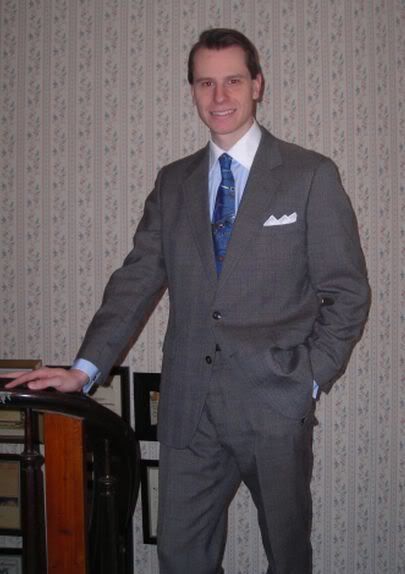
Modern suit
Vintage Champ homburg
Vintage overcoat
Modern tie
Modern spread collar shirt with French cuffs
Vintage cufflinks
Allen Edmond shoes


LinkWithin

Related Posts with Thumbnails