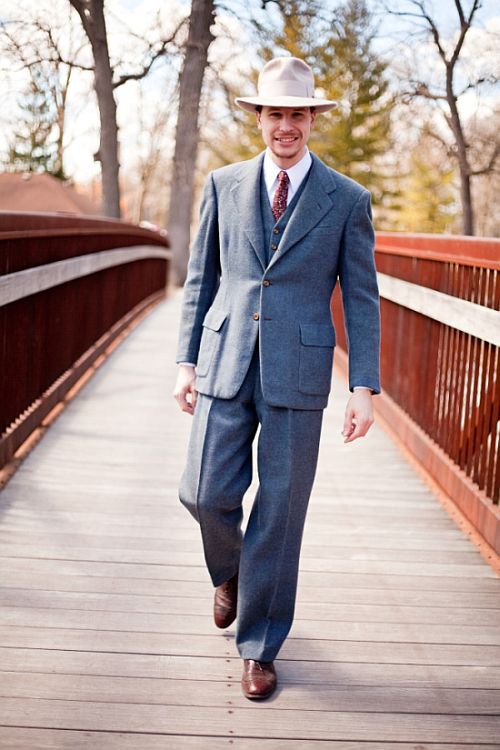
Thursday, January 12, 2012

On the Drape Suit, Part 2: a Short History

In On the Drape Suit, Part 1 we learned all about what makes a drape suit a drape suit: a correctly sized, well-fitted jacket with a full-cut chest, often with telltale vertical waves next to the armholes.

Now we're going to take a short look at the history of the drape suit.

The drape cut of a suit is believed to have begun during the early 1930s when cutter Frederick Scholte observed the drapey officer overcoats of the London's Brigade of Guards: full in the chest while being well-cut through the waist.

Before Scholte's moment of genious, suits were cut very close to the body. This type of close cut suit came, surprisingly, from the First World War.


click images to enlarge


Tailors of the post-WW1 era wrongly figured that the returning Doughboys would want tight fitting suits just like their tight fitting military uniforms. Tight chest, tight waist, tight sleeves, tight hips and narrow trouser legs. And pretty much up until the "Dawn of the Drape Suit" that's all they had.

But then came Frederick Scholte who spent several years perfecting the drape style and then made it his own at Anderson & Sheppard on Savile Row where it became popular with clients. Called at that moment in time the "London Cut", the drape style spread beyond Savile Row and most famously made an important stand in America where it influenced suit styles for the next 20 years.

In America during the late 1930s to the early 1940s the drape suit was often called the "Hollywood Drape suit", the "Contour suit", the "Blade suit", and just the plain "Drape suit", among others.


There were other unique styles that fall under the drape category such as the pleated front suit shown below.

Sears, Roebucks catalog, spring and summer, 1940:


Notice how the pleats accentuate the 'chestiness' of the jacket while still allowing the waist to be well suppressed. Below are modern photos of a pleated front sports coat that recently sold on Ebay for big bucks. Note the back pleats even while the jacket lacks a belted back. Also note the verticle chest waves.

The following photos via Marc Chevalier, 1930s sports coat:


The iconic Zoot Suit might also be considered a drape suit but that's for a different blog post.

Like it often does with many things, America took the drape suit to the extreme from the mid-1940s through to the early 1950s with the Bold Look. During the Bold Look the drape suit became a joke of itself: enormous shoulders and lapels, hugely full chest and baggy jacket body and skirt.

Boxy, top heavy, disproportionate. A far cry from the nicely proportioned drape suit of the late 1930s.


A joke of itself.

Once the Bold Look ran its course by the mid-1950s the drape suit finally died a quiet death with the invention of the sleek and clean-cut "Mr. T" suit and the "Mod" look, both topics for different posts.

Today the drape style has made a popular comeback in what is called "Neapolitan tailoring", a very confusing tailoring style that differs from tailor house to tailor house and even confounds the experts. I myself am confused as to what it is exactly, its characteristics ever-changing like the blowing sand dunes of an endless desert. One hapless trend at the moment seems to be pairing natural shoulders with a full-cut chest and a flaring jacket skirt. In other words, a hideous pear-shaped jacket with weak, sloping shoulders. Gnashing of teeth and heated arguments are sure to spring up at the very mention of its name and because of these issues I will go no further to attempt to explain Neapolitan tailoring.


What started as a bold statement and an exciting more casual style has now become a tired, much debated, often misunderstood and usually badly tailored debacle. It's sad to see the influential Drape Suit become such an enigma to so many iGents and tailors throughout the world.

Saturday, January 7, 2012

The Houndstooth Haberdashery

Exciting news for the Houndstooth Kid.


The blog has expanded onto Etsy so now readers can purchase quality vintage items at reasonable prices, some even from the blog.

Click the link below and see what you'll find.

The Houndstooth Kid Haberdashery

New items are continually being added so keep an eye on the Haberdashery.

Friday, December 9, 2011

Engagement Pics

Yup, engagement photos are here! Cassie and I are very happy with them. It was a beautiful day and had a great time with our photographer, Eric Yerke.

Enjoy.


click images to enlarge


Sunday, November 20, 2011

Shoes You Don't Just Wear

They say a woman first looks at a man's shoes and is able to tell a lot about him from his footwear. I don't know if this is true or not but I like to assume that it is. Better safe than sorry, right?

Maybe that's part of the reason I like shoes so much. Or maybe it has more to do with the idea of encasing one's feet, not really the prettiest part of the body, in something that's enjoyable to look at.


But it seems nowadays fewer men enjoy shoes; shoes are more or less utilitarian in this day and age. Men: if you're wearing shoes right now or have a pair laying around nearby, take a look at them. Are they pleasing to the eye? Do they make you happy (or as happy as shoes can make someone)? Are they stylish and classy? Hopefully you answered 'yes' to these questions.

If you did, you are one of the lucky few who get a small amount of joy out of wearing good quality, stylish footwear. Why the joy? Because stylish, comfortable, quality-made shoes are so hard to come by anymore. They can stand out from a crowd, if anyone's looking. And that's the point: the things that make nice shoes nice are in the details and will be lost on the average observer. Part of enjoying good footwear is the secret knowledge that your shoes are better than those worn by everyone else. Smug feet.

Check out the pair of shoes below.
They're vintage Stetson (no ties to the hat company) shoes made of alligator leather.


click images to enlarge


Very rare, very well made and a perfect fit for my large feet.

The patterns, colors and textures are something to behold. And they shined up like no other pair of shoes I've seen before, even better than true patent leather. You should have seen them when I first bought them: tossed away, scuffed, horribly creased, dusty, dirty, a price tag stapled through the side. Discarded.


I consider the shoes above to be wearable works of art. They were constructed decades ago by a skilled craftsman using some of the best materials and techniques available. Time, experience, sweat and maybe even some blood went into making them. That is something worth valuing and maintaining.

If a famous piece of artwork like "The Starry Night" is stolen, damaged or lost people around the world would rightfully be aghast. It's the same way with me when a pair of shoes like these are thrown out, left to rot or not cared for.


These aren't shoes you just wear. These are shoes you wear. You don't wear alligator shoes to go to Wal-Mart, you don't throw them on for a trip to the laundromat. You probably don't even want to wear them to church very often. These are special shoes mainly for the special occassions. Like that dinner suit in your closet or those special cufflinks in your drawer: you only break them out to celebrate.
The occasion makes the shoes special and the shoes help make the occasion even more special.

I guess that's why I like nice shoes.

Sunday, November 13, 2011

WIW: Plaid

I felt sporty today so I went with an ascot.

It's also Autumn, therefore I decided to wear my red plaid jacket for the first time.

I've been contemplating what to wear with this jacket for quite some time. It's a mid-1960s wool jacket that was most likely half of a suit at one point in time. It's very well made and fits me like a glove but the wild plaid pattern to it doesn't lend itself to coordinating very easily with other pieces. For that reason it's been in my possession for at least a year now and hadn't been worn until today.


click images to enlarge


Paired with gray flannel trousers, brown suede shoes, a pale green shirt, vintage blue and yellow ascot and vintage Hollywood-style fedora, I'm pretty happy with the results.


In the past loud plaid patterns have routinely fallen in and out of favor through the years. The Duke of Windsor, for example, often enjoyed a loud plaid suit as his tartan lounge suit below illustrates (in America tartan is one form of plaid).


And to further emphasize plaid's waxing and waning popularity throughout recent sartorial history, the Duke's tartan lounge suit was originally made in 1897 for his father, George V and then slightly altered for the Duke, who wore it with such success that is helped create a plaid craze in America during the 1950s.


There's nothing wrong with wearing loud plaids as long as the accoutrements compliment without adding to the loudness. At times this can be difficult but if done well it is very rewarding.

Monday, October 3, 2011

WIW: Reunited!

You may remember the mid-1930s belted back jacket I picked up from a local vintage shop 3 years ago.


click images to enlarge


When I first bought that jacket I assumed it was either a sports coat or an orphaned suit jacket, the trousers having been worn out and thrown away long ago. Finding vintage orphaned suit jackets is quite common.

Roughly a month ago I returned to that same local vintage shop and found, you guessed it, the matching pair of trousers. And three years later, a miracle! Both the jacket and trousers are made of the same blue worsted wool material with an unusual and rare woven plaid pattern.


So, after 3 long years the two pieces were reunited once again when I wore them yesterday.


While the jacket itself is amazing, the trousers step the entire outfit up a notch. Though flat-front, they have cuffs that are nearly 2" deep. Not only that, but the extremely wide and straight, full-cut legs measure a whopping 21" in circumference at the hem. Talk about wide-legged trousers!


Such wide, straight-legged trousers were common back during the late 1920s and early 1930s. Here's another suit of mine with such trousers, this one dating from the late 1920s:


Here's a pair of trousers with 22 inch in circumference legs from a 1932 Sears, Roebuck catalog. Also note the strange and unusual "trouser vest":


20 inch circumference trouser legs were still being advertised into the 1940s, the below ad being from the Spring/Summer 1940 edition of the Mont. Ward catalog:


It's very unusual to find the trousers to an orphaned vintage jacket, even more so after three years. I was quite lucky to find them especially since they add another layer of excellence to an already great jacket.

Thursday, September 29, 2011

On the Drape Suit, Part 1: Style

It was the most influential suit style of the Golden Era yet it is perhaps the least understood. Today it is (usually badly) imitated in what is known as "Neapolitan Tailoring" which is just as difficult to understand, is highly controversial and something I will not go into here.

The Drape Suit, quite simply, is a soft tailored style of suit that was first introduced in England during the 1930s, hence the name so often used to describe the style: English Drape. Other names for the Drape Suit include the "Blade Suit" or "Lounge Suit".

The Drape Suit has a few specific characteristics that seperates it from the other styles of the time. These characteristics include a full, soft chest often with vertical wrinkles or puckers; a gathered sleevehead; a well-tapered waist and padded shoulders. While a jacket may have some or all of these characteristics, the full chest is a must. Take a look at the late-1930s Drape sports coat below:


click images to enlarge


Although the above jacket lacks the 1gathered sleevehead, notice that it does have the 2well padded shoulders; the 3 full, soft chest with a vertical 'wave' and the 4highly suppressed waist. These are the vital characteristics of the vintage Drape Suit.
To quote "Esquire's Encyclopedia of 20th Century Men's Fashion" from 1973, the Drape Suit had a "...soft front, full across the chest and shoulder blades. Tapered sleeves with full sleevehead finished with tiny tucks at the shoulder. A decided suppression at the waist and close fitted at the hips...American interpretations eliminate the tiny tucks or pleats found at the top of the sleeveheads of the British models."


Trousers, though not as vital to the Drape Suit as the jacket, were cut very full and straight-legged, usually with pleats and generous cuffs.


Now remember that these are rules of thumb and may not apply to every Drape Suit. Just as the above Drape sports coat lacks the gathered sleevehead, another jacket may lack a different characteristic. The important thing is that the jacket has a full-cut chest and a fitted waist, giving the wearer an athletic appearance.


Here are some more examples of Drape Suits, all dating from the very early 1940s.


This is a 1941-dated tweed American suit. Notice, again, the full, soft-tailored chest with vertical waves in it. The jacket also has a small number of tucks at the sleevehead:


A 1940-dated American example of a Drape Suit. While difficult to see, the full-cut chest does have vertical waves.


This suit has well defined sleevehead tucks along with a lot of 'pooching' where the chest meets the armhole (indicating a full-cut chest) as the below image shows. Again, while the sleevehead tucks are not necessary, they often will be present.


Here is another example of a Drape Suit, this time from an ad found in an April, 1936 edition of the "New York Times". Take a look at the suit on the left and notice how the chest bows out: a full-cut chest.
The top of the sleeve just below the sleevehead also has vertical waves, indicating tucks at the sleevehead. While these waves may appear to be a flaw to the untrained eye, they have been carefully and purposefully placed there by the tailor.
"...our new 'Contour' model, emphasizing the broader-shoulder effect, fuller chest and slenderized hips."


Compared to the previous close-cut, body-hugging, well-structured suits of the 1920s, the Drape Suit is a more casual, soft-tailored style that was born out of the rough times of the 1930s and influenced men's suit styles through to the 1950s and even today. Because of this fact the Drape Suit needs to be better examined under the microscope of sartorial history.

The next time we look at the Drape Suit we'll do just that.

LinkWithin

Related Posts with Thumbnails